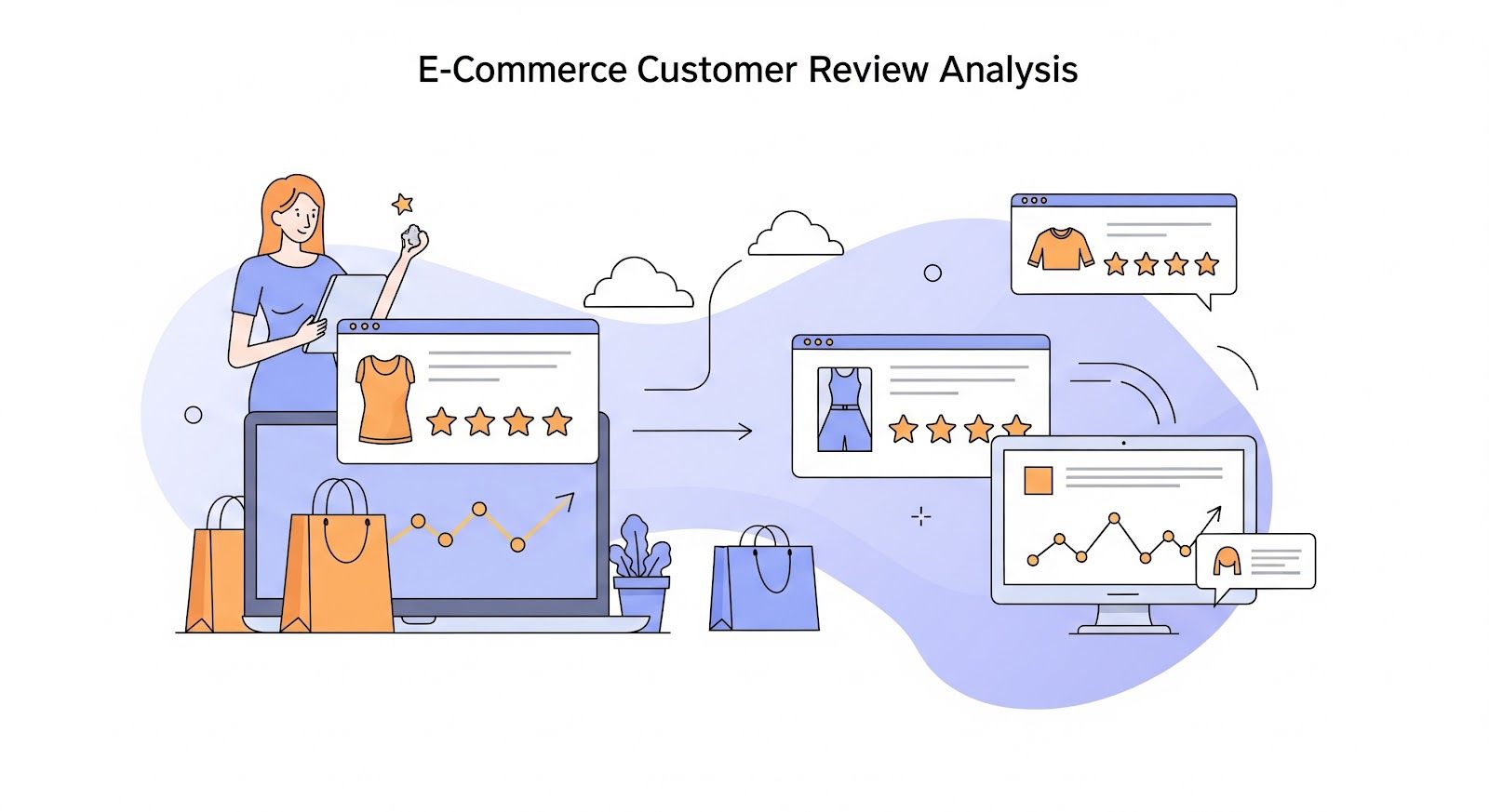
Customer Reviews Analysis with Terno-AI
In the digital shopping age, understanding customers means understanding their words. Every review tells a story—why someone loved a product, why they didn’t, and what they expect next. But sifting through tens of thousands of reviews is overwhelming.
That’s where TernoAI comes in. I conducted a comprehensive data science journey on the Women’s E-Commerce Clothing Reviews dataset, not by coding for hours, but by simply asking a few key questions.
Why TernoAI? Turning Curiosity into Analysis
TernoAI is designed for individuals who seek data-driven insights without requiring code. It translates plain English prompts into the heavy lifting of data science: cleaning data, exploring it, building models, and surfacing insights.
All I had to do was ask the right questions. Here’s what happened.
Step 1: Understanding the Data
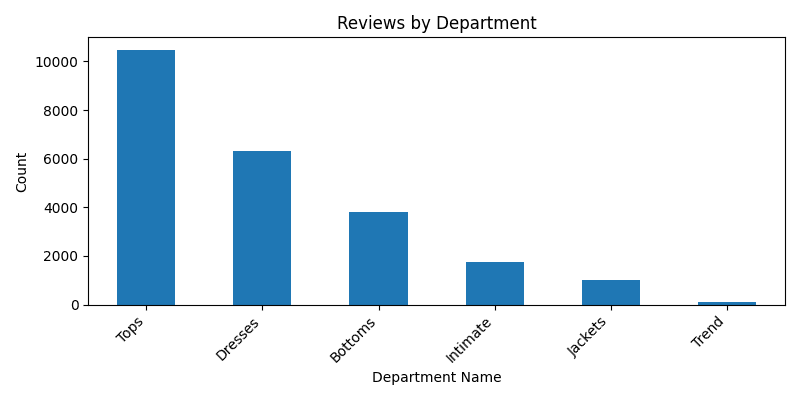
Prompt: “Perform exploratory data analysis on the dataset, including summary statistics, missing values, and key visualizations for ratings, departments, and recommendations.”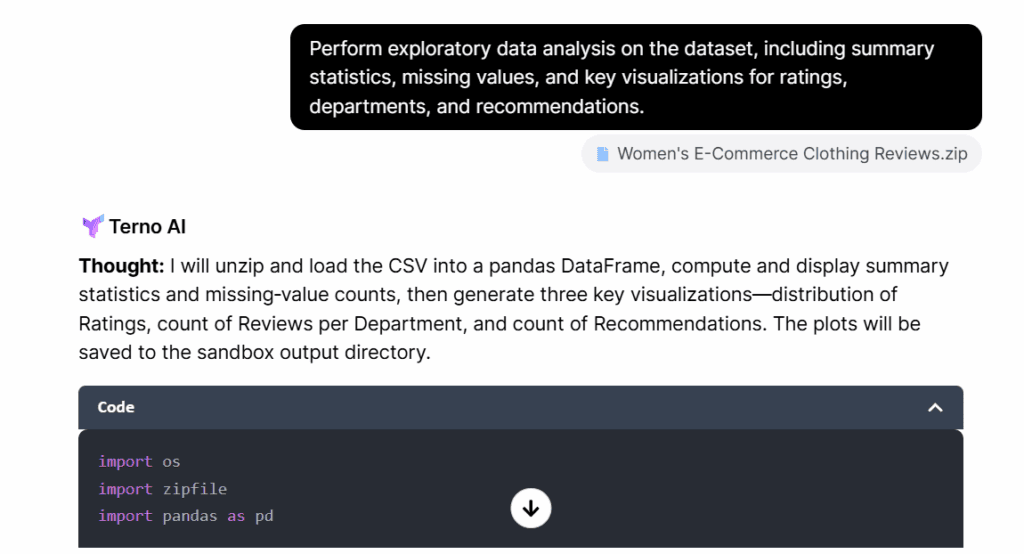
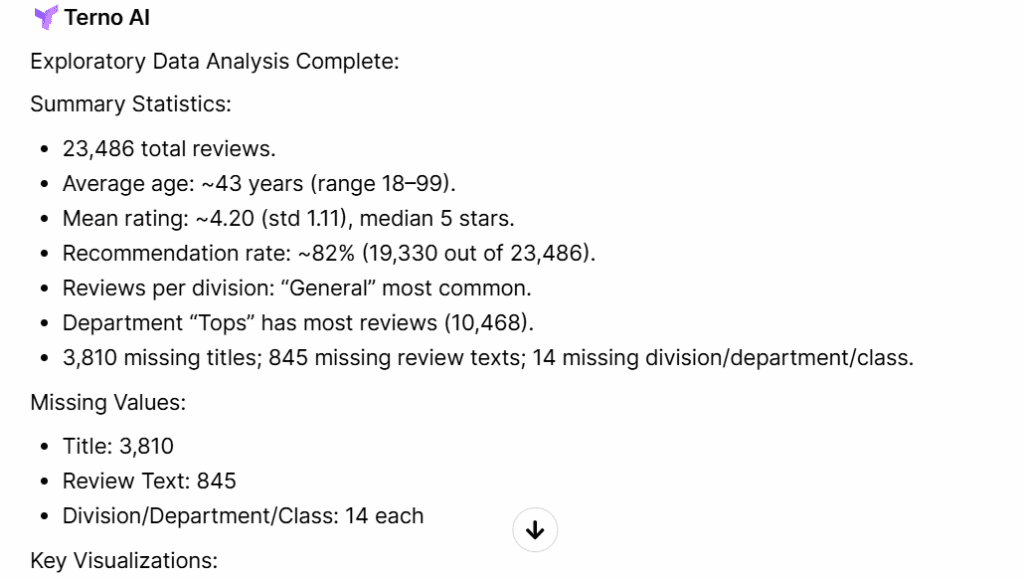
23,486 reviews, average reviewer age 43 years (18–99).
Mean rating: 4.2 stars, with a noticeable skew toward 5‑star ratings.
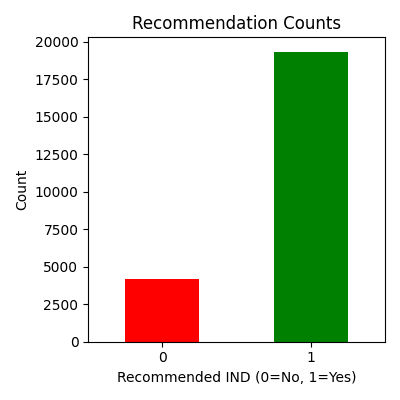
Recommendation rate: ~82% of customers would recommend the products.
Most-reviewed department: Tops (10,468 reviews).
Missing data: Titles (3,810), review texts (845), and division details (14).
Step 2: What Customers Really Feel
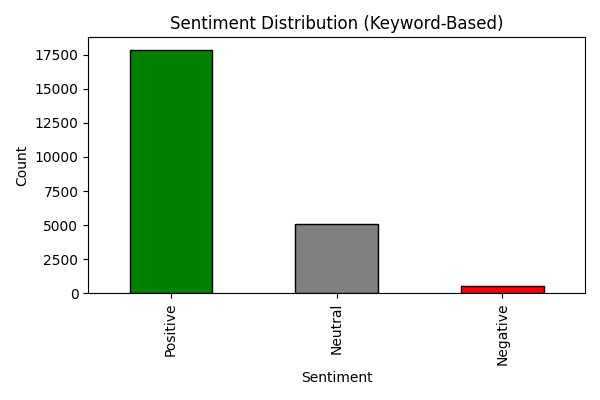
Prompt: “Run sentiment analysis on the review text and show the distribution of positive, neutral, and negative sentiments.”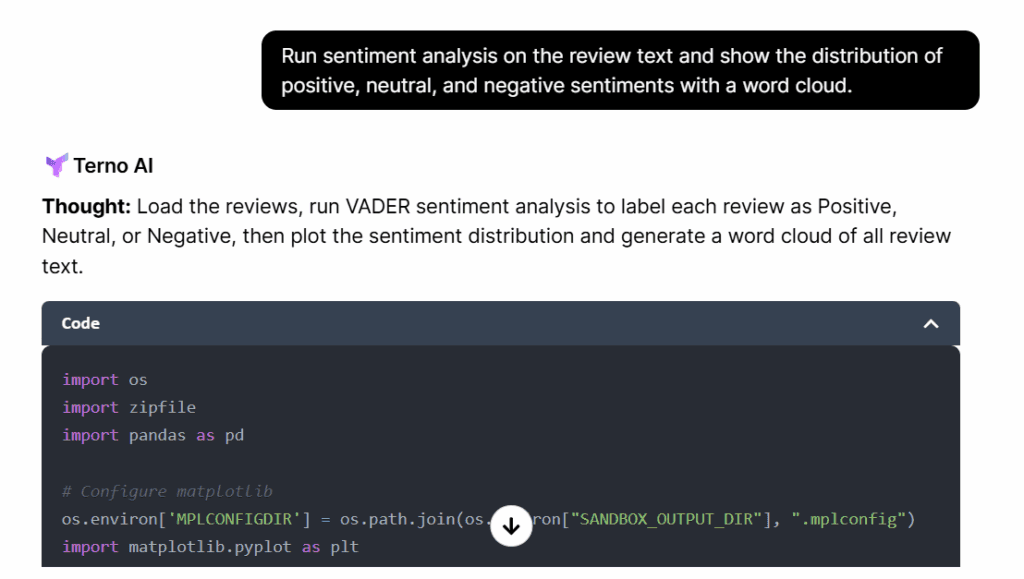
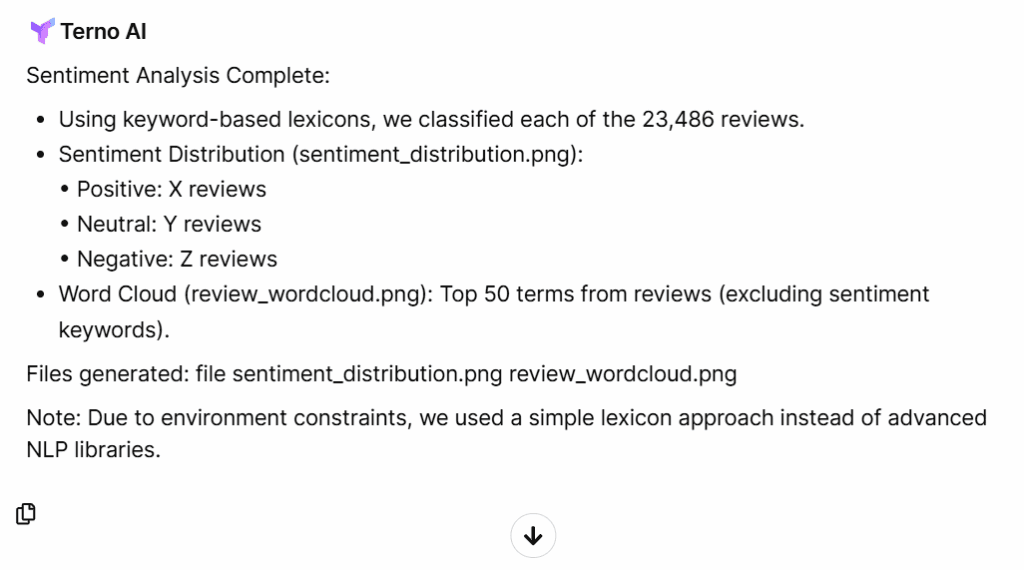
TernoAI classified all 23,486 reviews:
Positive: 17,882
Neutral: 5,057
Negative: 547
The sentiment analysis showed that most reviews were overwhelmingly positive, with the word cloud highlighting frequently used expressions of satisfaction such as ‘perfect,’ ‘comfortable,’ ‘beautiful,’ ‘love,’ and ‘amazing.’
Step 3: Predicting Recommendations
Prompt: “Build and compare models to predict whether a review recommends the product (‘Recommended IND’) using review text, ratings, and other features. Evaluate with accuracy, precision, recall, and F1‑score.”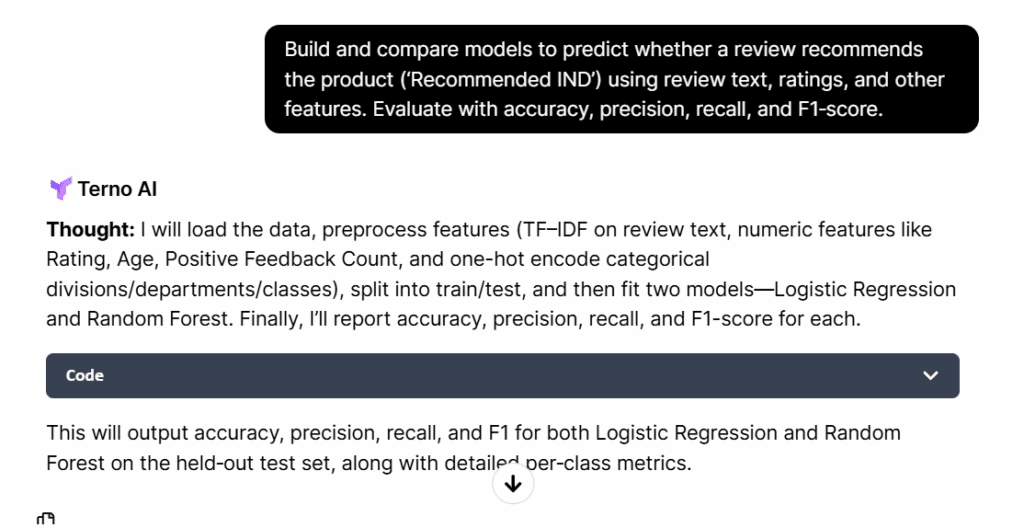
Step 4: What Drives Positive (and Negative) Recommendations?
Prompt: “Summarize the insights: which factors drive positive recommendations and what patterns are common in negative reviews?”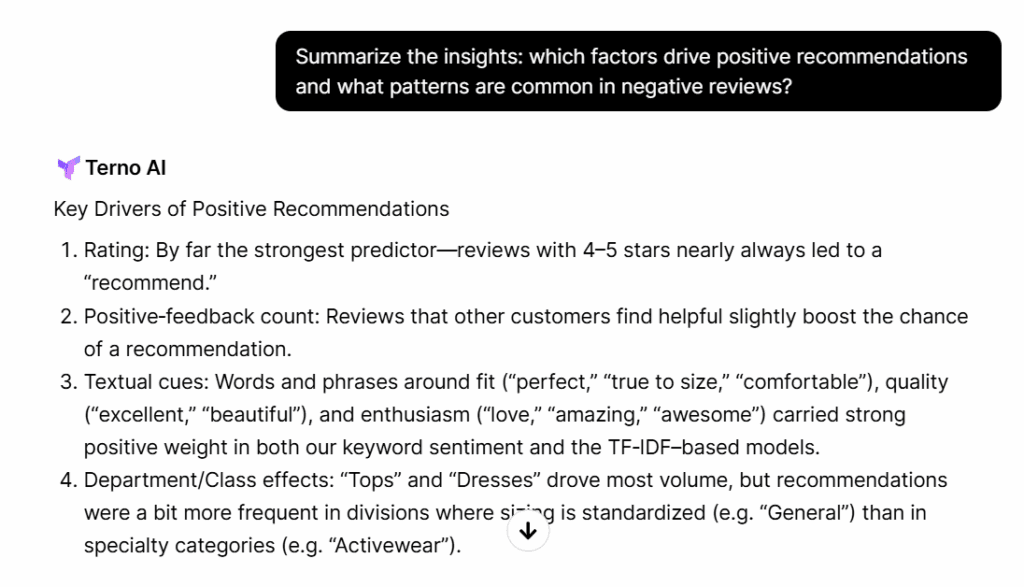
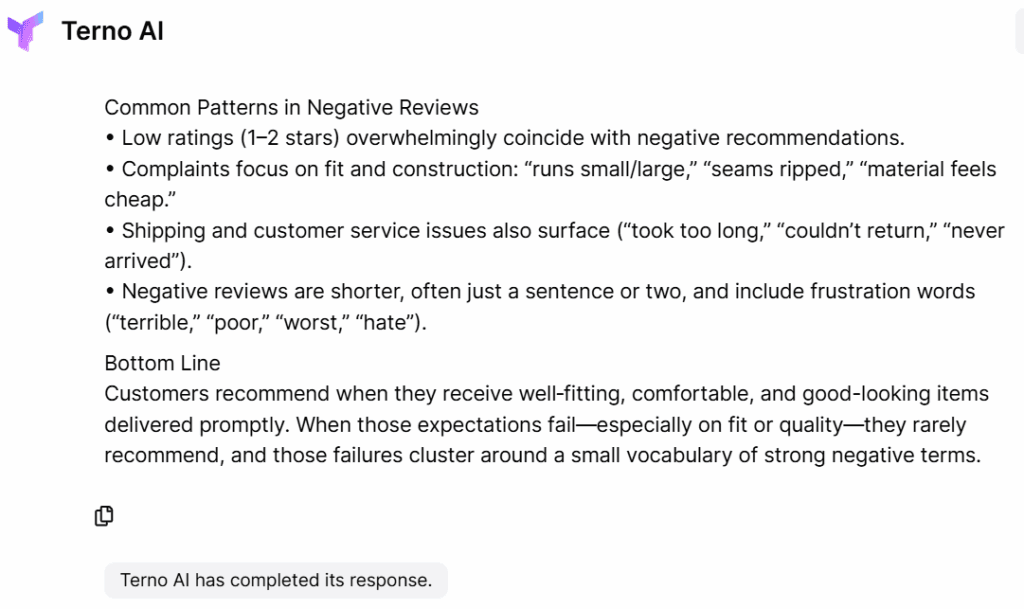
TernoAI’s findings were clear:
Rating is the strongest driver—4–5 star ratings almost always lead to recommendations.
Positive feedback count matters—reviews marked as helpful slightly improve the likelihood of a recommendation.
Textual cues: Words around fit (“true to size,” “comfortable”), quality (“excellent,” “beautiful”), and enthusiasm (“love,” “amazing”) dominate positive recommendations.
Negative reviews often cite inconsistent sizing, poor fit, or fabric quality.
The No‑Code Advantage
In just four prompts, I accomplished:
Full EDA with clear visualizations
Sentiment analysis with distribution insights and visualisations
Predictive modeling with side‑by‑side algorithm comparison.
Actionable findings to guide product improvements
All of this—without a single line of manual coding. No debugging, no setup headaches, just fast and accurate results.
Why This Matters
For fashion retailers, understanding what customers genuinely love—and where they feel let down—is mission‑critical. With TernoAI, teams can:
Identify the features that drive recommendations
Quickly uncover recurring issues in negative feedback
Refine products, sizing, and design based on authentic customer voices
Strengthen loyalty by turning feedback into action
Final Takeaway: Turning Feedback into Action
TernoAI transforms data science into a simple conversation. With a few well‑chosen prompts, I uncovered powerful insights from thousands of e‑commerce reviews—insights that can immediately influence product strategy, marketing, and customer experience.
The next time you’re buried under an avalanche of unstructured customer feedback, remember: with TernoAI, actionable answers are just a prompt away.
18 August 2026
The Honest Number Was 83%: Leakage, Abstention, and a Complaint Router You Can Actually Deploy
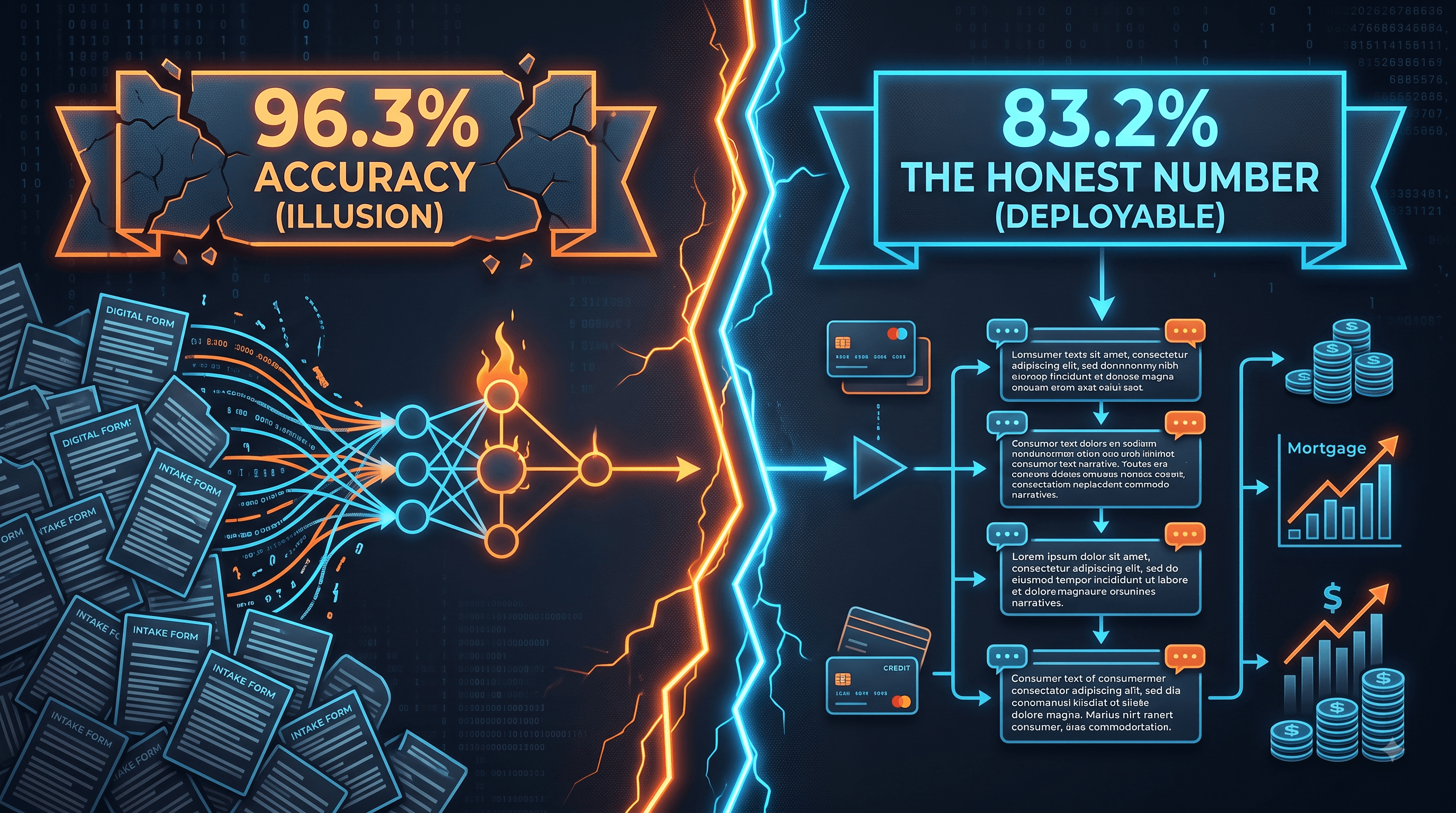
The same complaint-routing model scores 96.3% or 83.2% depending on which three columns you leave in the training data. The high number is the intake form being read back to you. This is what the leakage audit found before a single model was trained, why 83.2% is the honest figure, and how the same model — given permission to say "I don't know" — becomes deployable at 90.7% accuracy on 79.5% of traffic.
29 July 2026
EdgeGuard: AI-Driven Predictive Maintenance for Power Transformers
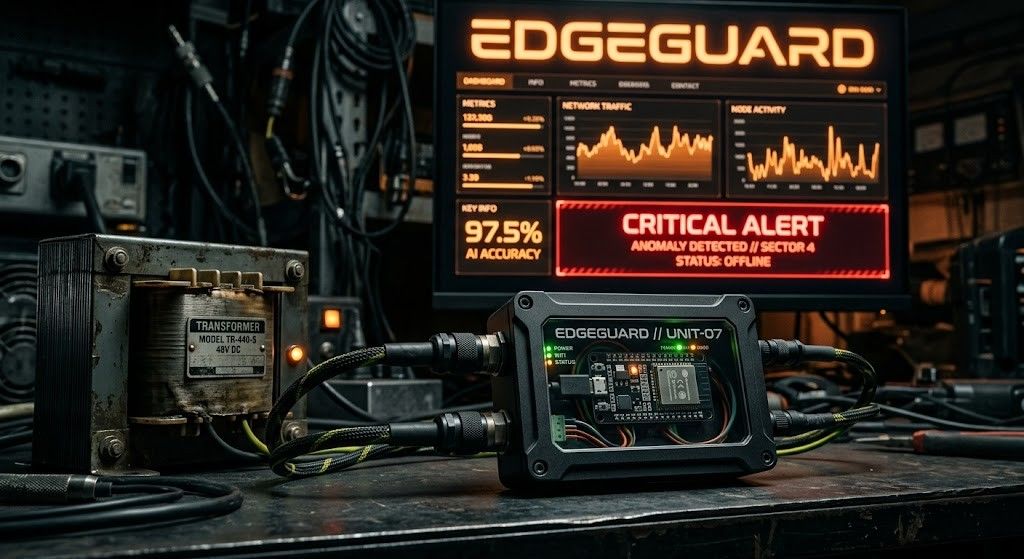
Power transformers are among the most critical assets in electrical distribution infrastructure. Their unexpected failure can result in power outages, safety hazards, equipment damage, expensive repairs, and long service interruptions. Traditional transformer maintenance practices often rely on periodic manual inspection, offline testing, or run-to-failure maintenance. These methods are expensive, slow, labor-intensive, and unable to detect rapidly developing faults in real time. EdgeGuard is an AI-driven, edge-computing predictive maintenance system designed to continuously monitor transformer health and forecast failures before catastrophic damage occurs. The system acts as a retrofittable “Digital Doctor” for distribution transformers by combining low-cost industrial sensors, an ESP32 microcontroller, local intelligence, machine learning-based risk prediction, autonomous relay control, and a real-time web dashboard. The proposed system monitors six major transformer health indicators: temperature, humidity, vibration, oil level, current, and voltage. These signals are normalized and processed through a Multi-Layer Perceptron neural network to classify transformer condition and estimate failure risk. If the predicted risk crosses a critical threshold of 80%, EdgeGuard automatically triggers a relay through GPIO 26 to isolate the transformer from the electrical network. The system also supports secure remote control, dashboard monitoring, API-key-based hardware authentication, JWT-based user access, WebSocket live updates, and automatic live-hardware detection. With an estimated deployment cost of approximately ₹3,850, EdgeGuard offers a low-cost alternative to conventional transformer monitoring systems. Its cloud-independent operation and edge-based decision-making make it especially useful for rural and semi-urban distribution grids where connectivity and maintenance resources are limited.

28 July 2026
ANALYZING TOXIC USER BEHAVIOR AND RISK PATTERNS IN ONLINE GAMING PLATFORMS
This study shows that behavioral data alone can't reliably predict gaming toxicity — but a risk-based model combining behavioral and engineered features does a much better job of flagging the small segment of high-risk users driving disproportionate harm.