
Introduction: The Problem FinTech Teams Face Today
Crypto and FinTech markets move at a speed that traditional market analysis struggles to match. User sentiment can shift in days sometimes hours driven by price movements, regulatory news, or product launches. Yet most FinTech teams still rely on lagging indicators such as transaction data, quarterly reports, or retrospective market studies. By the time those signals surface, user intent has already changed.
Search behavior offers a powerful alternative. People search before they invest, before they onboard, before they panic, and before they comply. However, raw search data is massive, fragmented, and difficult to translate into business insight at scale.
This creates a persistent market intelligence gap:
Product teams don’t know what users are moving toward next
Growth teams struggle to identify where demand is forming
Compliance teams react after sentiment has already shifted
This blog shows how TERNO addresses that gap by transforming Google Trends data into prompt-driven FinTech market analysis , turning early intent signals into actionable intelligence.
The Approach: Prompt-Driven Analysis with TERNO
TERNO acts as an agentic analytical system that:
converts real-world market uncertainties into structured prompts
queries Google Trends data programmatically
analyzes longitudinal, geographic, and comparative patterns
translates raw metrics into decision-ready insights
Each section below shows the prompt TERNO executes, and concludes with why the output matters for FinTech decision-making.
1. Are users shifting from direct crypto ownership to ETFs?
As Bitcoin ETFs enter mainstream financial markets, FinTech teams need to understand whether retail users are truly moving toward regulated, institutional products or if direct ownership still dominates.
Prompt
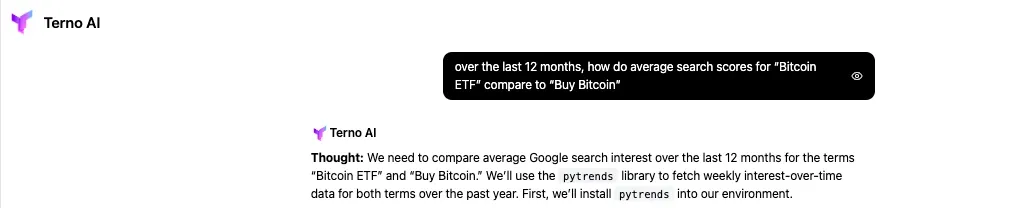
_"Over the last 12 months, how do average search scores for “Bitcoin ETF” compare to _“Buy Bitcoin”?"
What TERNO Found
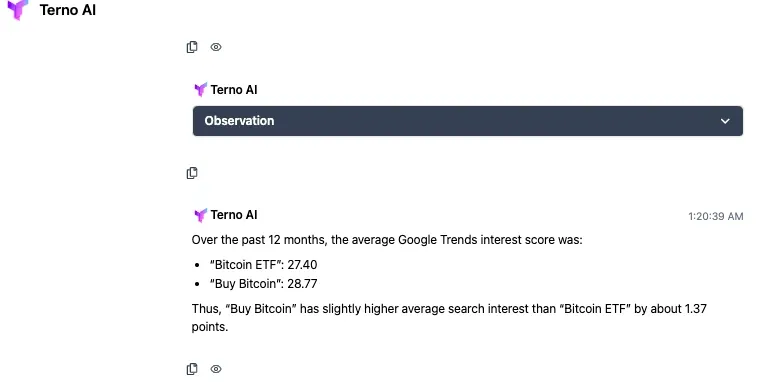
Bitcoin ETF: 27.40
Buy Bitcoin: 28.77
Direct purchase queries remain slightly higher.
Why This Matters
Retail users continue to show strong preference for direct ownership, even as ETF awareness grows. This suggests:
spot-buy onboarding remains critical
ETFs complement rather than replace direct crypto access
wallets and exchanges remain central to retail adoption
2) Which exchanges actually dominate user attention?
In a crowded exchange ecosystem, brand awareness often determines where users begin their journey. Market share data alone doesn’t reveal who users are thinking about.
Prompt
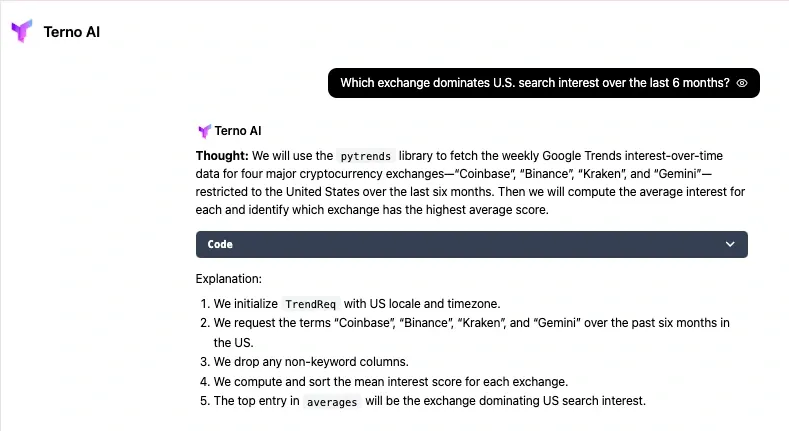
"Which exchange dominates U.S. search interest over the last 6 months?"
What TERNO Found
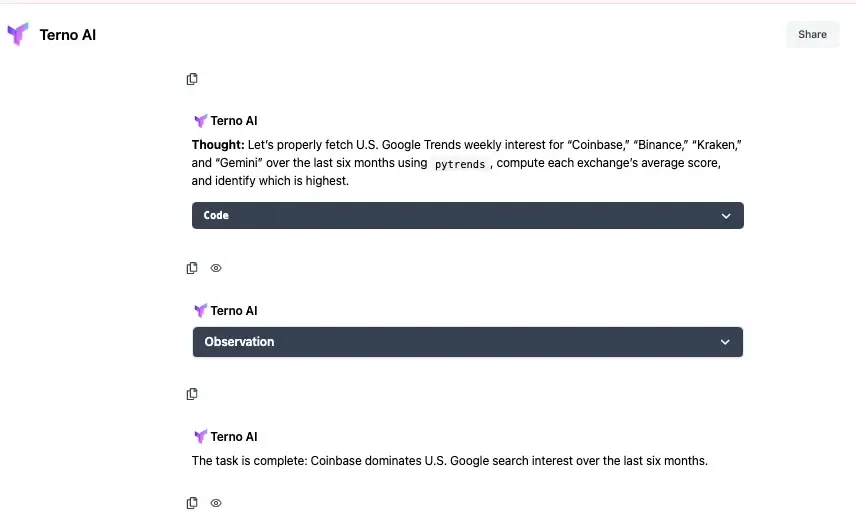
Coinbase consistently leads U.S. search interest compared to Binance, Kraken, and Gemini.
Why This Matters
Search dominance reflects:
higher brand trust
stronger top-of-funnel presence
lower acquisition friction
Competing platforms can use this insight to sharpen differentiation around fees, custody, UX, or geographic focus.
3) Do price surges drive new user curiosity?
Bitcoin price rallies often bring waves of new users, but FinTech teams need to know whether curiosity genuinely spikes during these moments or if attention is limited to existing participants.
Prompt
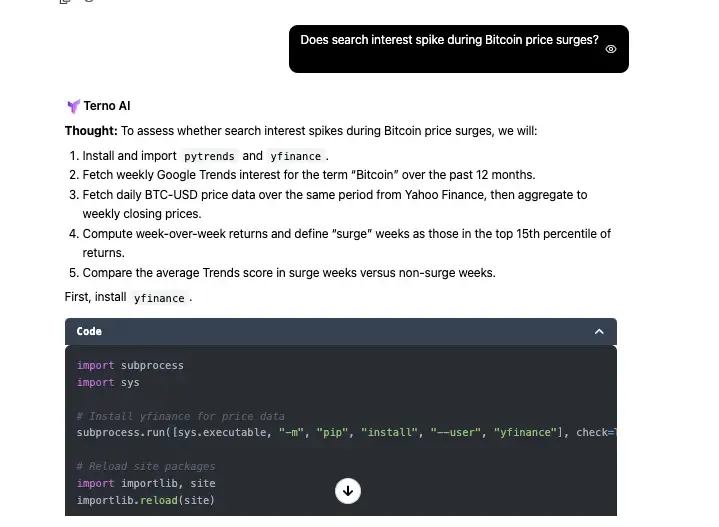
"Does search interest in “Bitcoin” increase during Bitcoin price surges?"
What TERNO Found
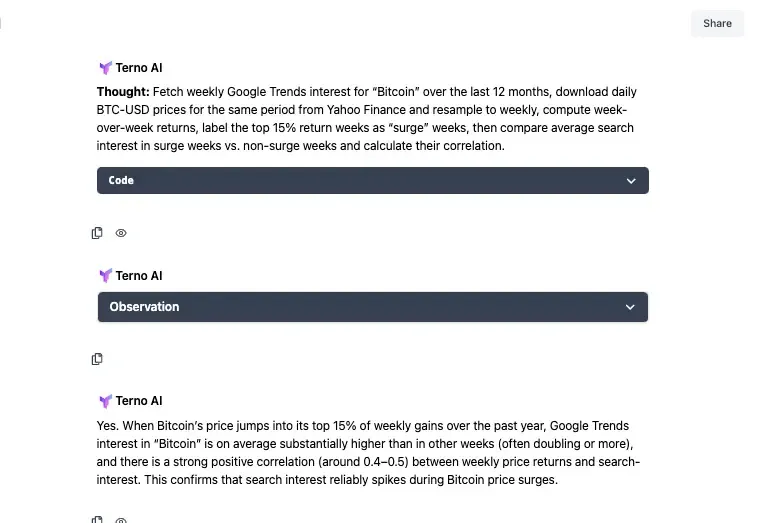
Search interest rises sharply during the top 15% of weekly BTC gains
Positive correlation between weekly price returns and search interest (~0.4–0.5)
Why This Matters
Search spikes act as an early signal of incoming demand, enabling teams to:
prepare onboarding flows
scale infrastructure
deploy educational content
manage liquidity and support load proactively
** 4) How do crypto failures influence regulatory concern?**
Major crypto collapses are assumed to trigger regulatory panic, but not every failure resonates equally with users.
Prompt
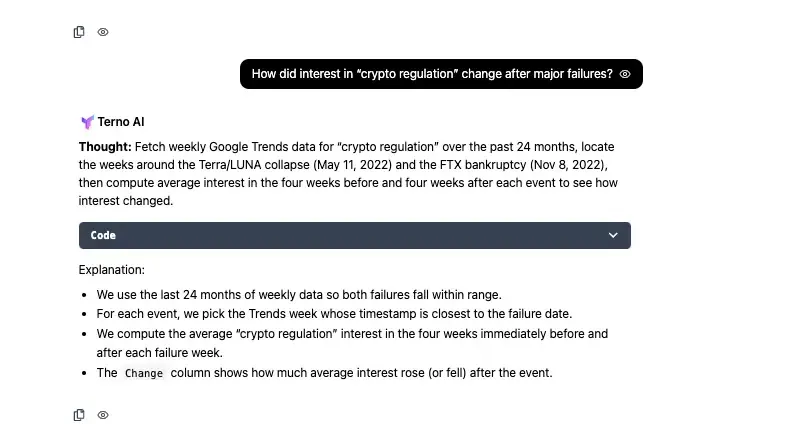
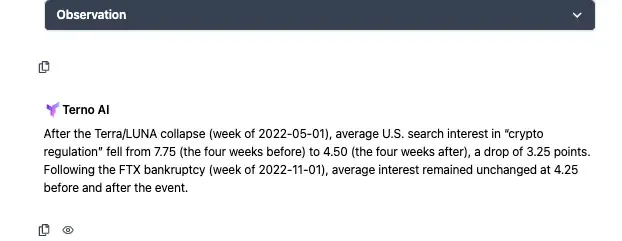
"How did interest in “crypto regulation” change after major crypto failures"?
What TERNO Found
Strong peaks in February–April
Lowest interest in summer and early fall
Why This Matters
Clear seasonality enables:
better timing of tax-tool launches
targeted CPA partnerships
smarter marketing spend allocation
5) When do users care about crypto taxes?
Crypto taxation is complex, but user attention is not constant throughout the year. FinTech teams need to know when demand actually peaks.
Prompt
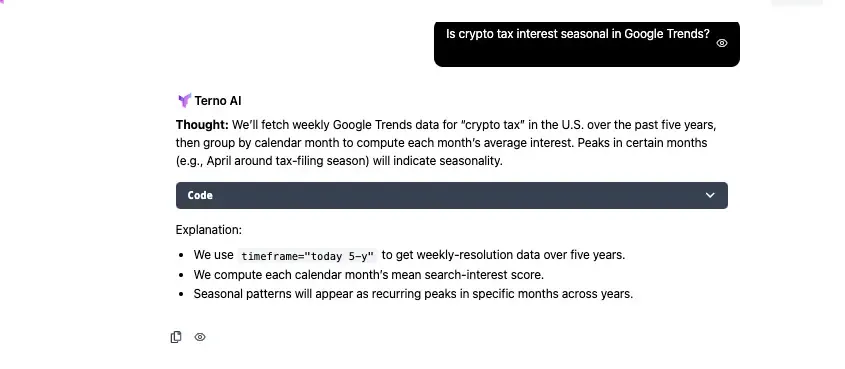
"Is search interest for “crypto tax” seasonal" ?
What TERNO Found
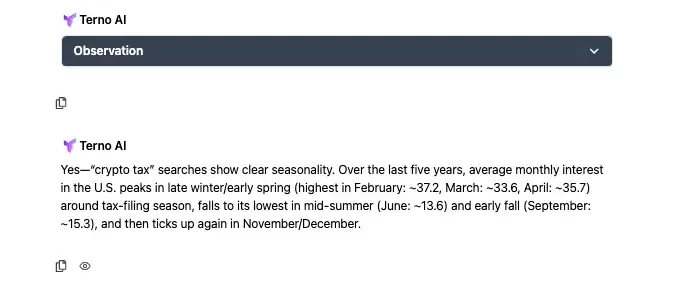
Strong peaks in February–April
Lowest interest in summer and early fall
Why This Matters
Clear seasonality enables:
better timing of tax-tool launches
targeted CPA partnerships
smarter marketing spend allocation
6) Where is crypto tax demand geographically concentrated?
National averages hide local intensity. Some regions face significantly higher crypto tax engagement than others.
Prompt
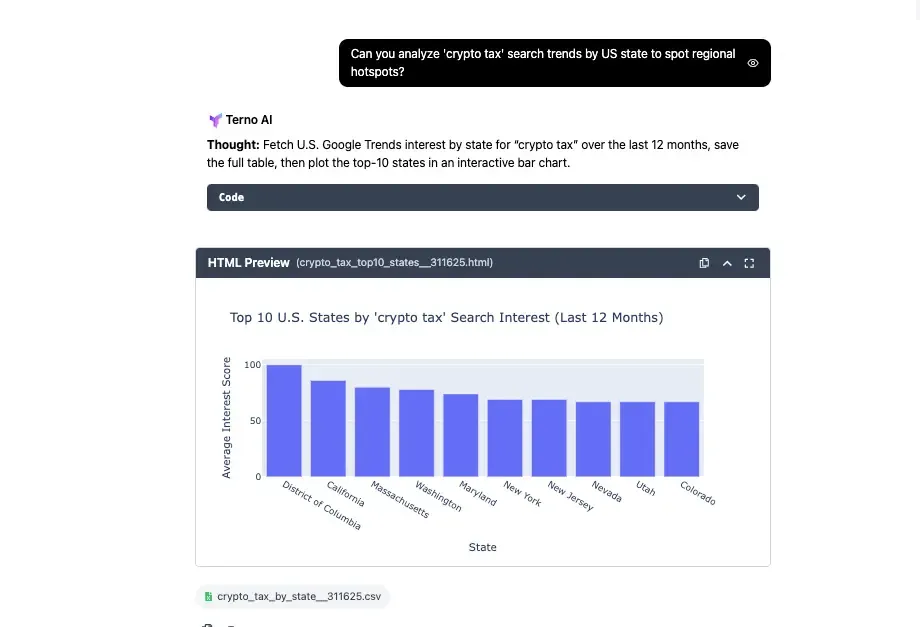
"Can you analyze ‘crypto tax’ search trends by US state to spot regional hotspots"?
What TERNO Found
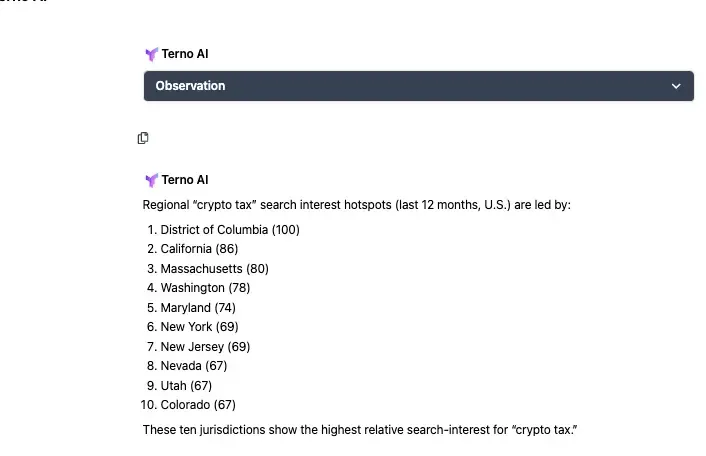
Top regions include:
District of Columbia
California
Massachusetts
Washington
Maryland
New York
Why This Matters
Geographic insights support:
localized outreach and education
region-specific compliance focus
state-level partnership strategies
7) Which crypto narratives are more volatile over time?
Not all crypto interest behaves the same. Retail-driven queries may be hype-driven, while institutional narratives could be steadier.
Prompt
"Conduct a comparative analysis of the longitudinal search variance between spot investment queries and institutional product terms within the United States".
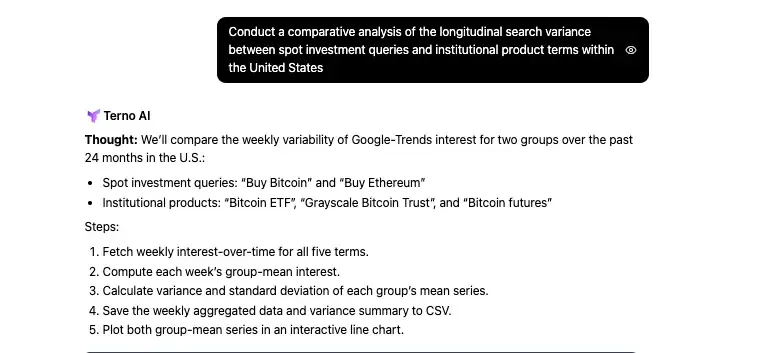
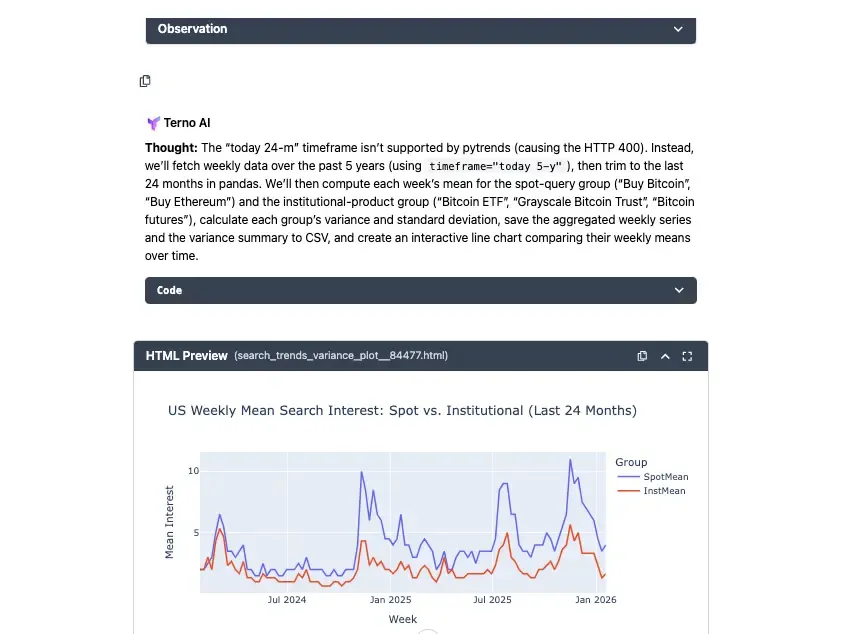
What TERNO Found
- Spot queries are ~4× more volatile than institutional product searches
Why This Matters
Spot demand follows sentiment and price cycles
Institutional interest is more stable and predictable
This helps FinTech teams balance short-term growth tactics with long-term product strategy.
8) Can search interest act as a market signal?
Price alone doesn’t capture sentiment. FinTech teams need additional indicators to anticipate market momentum.
Prompt
"Over the last 5 years, what is the correlation between the weekly average search interest for “Bitcoin” with the weekly Bitcoin price"?
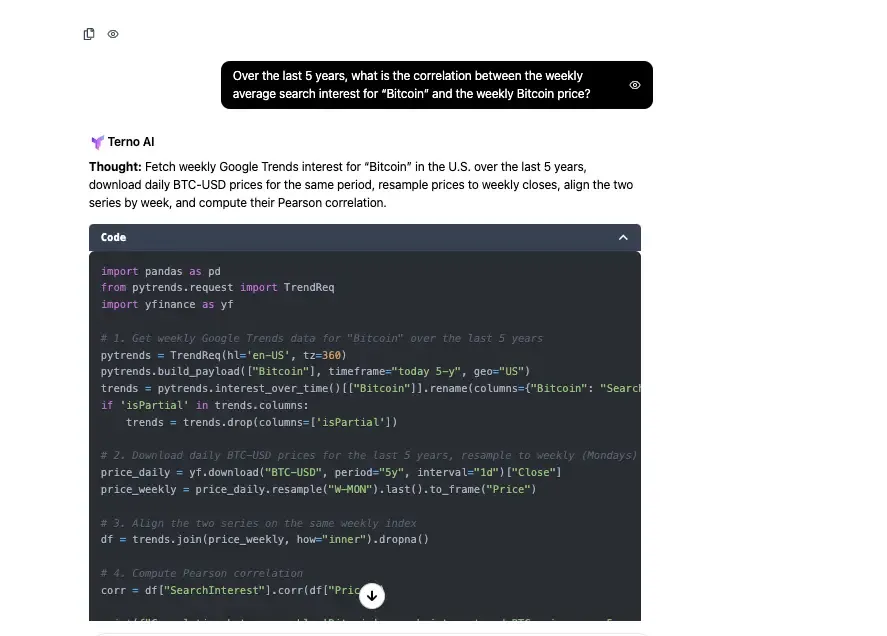
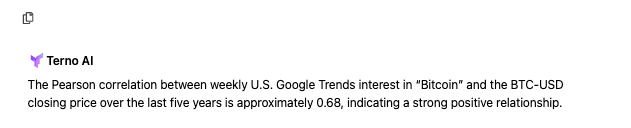
What TERNO Found
- Pearson correlation ≈ 0.68
Why This Matters
Search interest functions as a sentiment proxy, strengthening:
demand forecasting
volatility monitoring
operational planning
** 9) How do regional preferences differ in Europe?**
Global crypto behavior is not uniform. Product assumptions that work in one region may fail in another.
Prompt
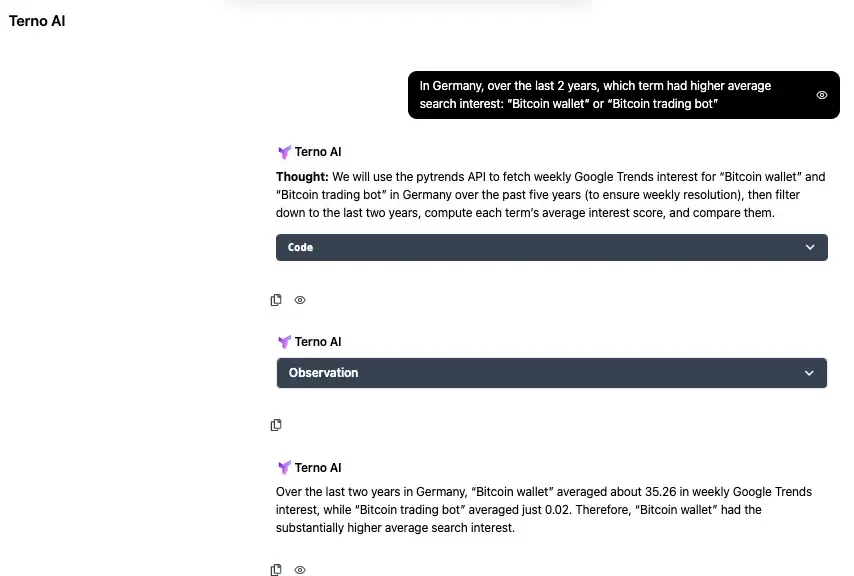
"_ In Germany, over the last 2 years, which term had higher average search interest: "Bitcoin wallet" or Bitcoin trading bot? _"
What TERNO Found
- Bitcoin wallet interest far exceeds trading bot interest
Why This Matters
German users prioritize:
custody
security
compliance
Automated trading narratives resonate far less, shaping how products should be positioned.
Conclusion: Closing the Market Intelligence Gap with TERNO
Across all prompts, TERNO demonstrates how search behavior becomes strategic market intelligence when analyzed systematically.
By transforming Google Trends data into prompt-driven analysis, TERNO enables FinTech teams to:
identify demand shifts early
track sentiment cycles
localize strategy geographically
align products with real user intent
Instead of reacting after the market moves, TERNO helps teams understand what is changing now and why it matters.
Explore the full analysis@
https://sandra1.app.terno.ai/chat/share/37f20524-f8d7-4b42-bca4-35de33673ad5?ui_version=v1
**Book a demo@ **https://terno.ai/to see how TERNO transforms search behavior into actionable FinTech intelligence.

18 August 2026
The Honest Number Was 83%: Leakage, Abstention, and a Complaint Router You Can Actually Deploy
The same complaint-routing model scores 96.3% or 83.2% depending on which three columns you leave in the training data. The high number is the intake form being read back to you. This is what the leakage audit found before a single model was trained, why 83.2% is the honest figure, and how the same model — given permission to say "I don't know" — becomes deployable at 90.7% accuracy on 79.5% of traffic.

29 July 2026
EdgeGuard: AI-Driven Predictive Maintenance for Power Transformers
Power transformers are among the most critical assets in electrical distribution infrastructure. Their unexpected failure can result in power outages, safety hazards, equipment damage, expensive repairs, and long service interruptions. Traditional transformer maintenance practices often rely on periodic manual inspection, offline testing, or run-to-failure maintenance. These methods are expensive, slow, labor-intensive, and unable to detect rapidly developing faults in real time. EdgeGuard is an AI-driven, edge-computing predictive maintenance system designed to continuously monitor transformer health and forecast failures before catastrophic damage occurs. The system acts as a retrofittable “Digital Doctor” for distribution transformers by combining low-cost industrial sensors, an ESP32 microcontroller, local intelligence, machine learning-based risk prediction, autonomous relay control, and a real-time web dashboard. The proposed system monitors six major transformer health indicators: temperature, humidity, vibration, oil level, current, and voltage. These signals are normalized and processed through a Multi-Layer Perceptron neural network to classify transformer condition and estimate failure risk. If the predicted risk crosses a critical threshold of 80%, EdgeGuard automatically triggers a relay through GPIO 26 to isolate the transformer from the electrical network. The system also supports secure remote control, dashboard monitoring, API-key-based hardware authentication, JWT-based user access, WebSocket live updates, and automatic live-hardware detection. With an estimated deployment cost of approximately ₹3,850, EdgeGuard offers a low-cost alternative to conventional transformer monitoring systems. Its cloud-independent operation and edge-based decision-making make it especially useful for rural and semi-urban distribution grids where connectivity and maintenance resources are limited.

28 July 2026
ANALYZING TOXIC USER BEHAVIOR AND RISK PATTERNS IN ONLINE GAMING PLATFORMS
This study shows that behavioral data alone can't reliably predict gaming toxicity — but a risk-based model combining behavioral and engineered features does a much better job of flagging the small segment of high-risk users driving disproportionate harm.