
From Global Trends to Consumer Reality: Uncovering Hidden Patterns in Skincare Behavior through Data-Driven Segmentation
The skincare industry is rapidly evolving, with growing interest in aesthetic procedures alongside strong organic product usage. This study integrates large-scale consumer data with global and geographical trends to examine real consumer behavior. The results show that trends do not directly drive consumer satisfaction, while machine learning reveals distinct behavioral patterns. These findings highlight the need for a deeper, data-driven understanding of modern skincare dynamics.
An Integrated Analysis of Global Trends, Geographical Variation, and Machine Learning-Based Behavioral Segmentation
Executive Summary
The global skincare industry is undergoing a significant transformation, driven by the rising popularity of advanced aesthetic procedures alongside the continued dominance of traditional and organic skincare products. While global trends indicate increasing interest in injectable and aesthetic treatments, it remains unclear how these trends influence actual consumer behavior and product satisfaction.
This study presents a data-driven framework that integrates large-scale consumer review data with global trend data and geographical insights to evaluate the relationship between skincare trends and consumer behavior. Using over 1.3 million product reviews combined with Google Trends data, the analysis examines temporal patterns, regional variations, and behavioral responses within the cosmetics market.
The findings reveal that aesthetic skincare interest has increased consistently over time; however, organic skincare continues to dominate across most countries. Significant geographical variation exists, with only a limited number of markets showing strong aesthetic preference. Importantly, the analysis shows no direct relationship between global trends and user ratings, indicating that consumer satisfaction is not driven solely by trend dynamics.
To further explore underlying patterns, machine learning-based clustering was applied, revealing distinct behavioral segments within the market. The results demonstrate that products exposed to similar trend conditions can exhibit significantly different rating behaviors, highlighting the complexity and heterogeneity of consumer responses.
Overall, the study emphasizes that global trends alone are insufficient to explain consumer behavior. Instead, a multi-level analytical approach combining trend analysis, geographical insights, and behavioral segmentation is required to fully understand the evolving dynamics of the skincare industry. The proposed framework provides a scalable and practical methodology for analyzing similar trend-behavior relationships across different domains.
1. Introduction
The global beauty and personal care industry has experienced a significant transformation in recent years, driven by the increasing popularity of both traditional skincare products and advanced aesthetic procedures. In particular, non-invasive cosmetic treatments such as injectable aesthetics (e.g., Botox) have gained substantial attention worldwide, reflecting a shift in consumer awareness, expectations, and preferences.
At the same time, organic and traditional skincare products continue to play a dominant role in daily consumer routines, supported by growing interest in natural ingredients, sustainability, and long-term skin health. This coexistence of traditional and modern beauty approaches has created a complex landscape where global trends may not necessarily align with actual consumer behavior across different regions.
Understanding how these trends evolve over time and how they vary geographically is critical for businesses, researchers, and policymakers. While global trend indicators (such as search interest) suggest increasing adoption of aesthetic procedures, it remains unclear whether this growth is uniformly reflected across countries or if regional differences significantly influence consumer preferences.
This document explores the relationship between global skincare trends and country-level preferences by integrating time-based trend data and geographical analysis. The aim is to provide a structured, data-driven understanding of how organic and aesthetic skincare interests evolve and how these patterns differ across regions.
2. Problem Statement
The rapid growth of the global beauty industry has been accompanied by a noticeable rise in interest in advanced aesthetic procedures, particularly non-invasive treatments such as injectable skincare (e.g., botox). At the same time, traditional and organic skincare products continue to dominate everyday consumer routines across many regions. While global trend indicators, such as search interest data, suggest increasing attention toward aesthetic procedures, it remains unclear how these trends translate into actual consumer behavior.
Current analytical approaches often rely on either consumer data (e.g., product reviews and ratings) or external trend data (e.g., search trends) in isolation. This separation limits the ability to understand whether global aesthetic trends meaningfully influence consumer perceptions and satisfaction with traditional cosmetic products. Furthermore, most studies assume a direct relationship between rising trends and changes in consumer behavior, without validating whether such relationships exist in real-world data.
Another key challenge lies in the assumption of uniform consumer behavior across markets. Global trends are typically analyzed at an aggregated level, overlooking potential regional differences and the possibility that consumers may respond differently to the same trend conditions. As a result, existing approaches fail to capture the complexity of consumer behavior, particularly in a landscape where traditional and modern skincare approaches coexist.
In addition, there is limited exploration of whether distinct behavioral segments exist within the market. Even under similar global trend conditions, consumers and products may exhibit varying levels of satisfaction, suggesting the presence of underlying factors not captured by trend data alone.
Therefore, the core problem addressed in this study is: to determine whether rising global interest in aesthetic skincare trends is associated with changes in consumer behavior, and to identify whether distinct behavioral segments exist under similar trend conditions.
This problem highlights the need for an integrated, data-driven approach that combines trend data, consumer behavior data, and advanced analytical techniques to provide a more comprehensive understanding of the relationship between global trends and actual market behavior.
3. Existing Approaches and Limitations
Existing research in the cosmetics and skincare domain has primarily focused on analyzing consumer behavior using either transactional data (e.g., product reviews, ratings, and purchase history) or external indicators such as online search trends and social media engagement. Studies using user-generated content, particularly online reviews, have demonstrated their effectiveness in understanding consumer sentiment, product perception, and purchasing behavior. For example, review-based analysis has been widely used to evaluate customer satisfaction and product quality using natural language processing and statistical techniques [1].
In parallel, tools such as Google Trends have been increasingly adopted to capture public interest and emerging patterns in consumer demand. Prior work has shown that search trend data can provide valuable insights into market dynamics and has been applied in domains such as healthcare, finance, and marketing to track user interest over time [2]. However, while such approaches effectively capture macro-level trends, they do not directly reflect actual consumer decisions or satisfaction.
A major limitation of existing approaches is the lack of integration between trend-level data and behavior-level data. Most studies analyze these data sources independently, assuming that an increase in trend popularity directly translates into changes in consumer behavior. This assumption is often not validated empirically. Research in consumer behavior suggests that purchasing decisions are influenced by a wide range of factors, including product attributes, perceived value, and individual preferences, rather than external trends alone [3].
Furthermore, traditional analytical methods frequently assume homogeneous consumer behavior, overlooking the variability across different user groups, products, and markets. In reality, consumers exposed to the same external trends may respond differently depending on contextual and psychological factors. This highlights the need for more granular analysis that can capture heterogeneity within the data.
Another limitation is the underutilization of machine learning techniques for behavioral segmentation. While predictive models have been widely used in recommendation systems and rating prediction tasks, their effectiveness depends heavily on the availability of rich and diverse features. In cases where feature space is limited or weakly informative, predictive models often fail to provide meaningful insights. In contrast, unsupervised learning techniques such as clustering have been shown to be effective in identifying latent patterns and grouping entities based on similarity without requiring strong predictive relationships [4].
Despite these advancements, there remains a gap in applying such techniques to jointly analyze global trends and consumer rating behavior within the cosmetics domain. Existing studies rarely explore whether similar trend conditions can lead to different behavioral outcomes, or whether distinct segments of products or consumers emerge under the same external influences.
The limitations of current approaches can be summarized as:
Lack of integration between trend data and consumer behavior data
Over-reliance on assumptions of direct trend-behavior relationships
Limited consideration of regional and contextual variability
Ineffective use of predictive models in low-signal environments
Insufficient application of clustering techniques for behavioral segmentation
These limitations motivate the need for a more integrated and exploratory analytical framework that combines trend analysis with behavioral segmentation to better understand consumer dynamics in the evolving skincare market.
4. Proposed Solution: Terno AI
The limitations identified in existing approaches highlight the need for an integrated analytical framework capable of combining multiple data sources and extracting meaningful insights from both trend-level and behavior-level data. To address this, this study proposes a data-driven solution implemented using Terno AI, an agentic data science platform that enables structured data exploration, transformation, and analysis through guided prompts.
4.1 Overview of the Proposed Approach
The proposed solution integrates three key analytical components:
- Trend Analysis (Time-Based)
- Geographical Analysis (Country-Level Preferences)
- Behavioral Analysis (User Ratings and Clustering)
These components are combined into a unified workflow to evaluate the relationship between global skincare trends and consumer behavior.
4.2 Data Integration Framework
The solution begins with the construction of a unified dataset by combining:
A large-scale Amazon cosmetics review dataset containing over 1.3 million records, including product ratings, categories, and timestamps
Google Trends data, capturing global interest in:
- Aesthetic skincare (injectable procedures)
- Organic skincare (traditional products)
Geographical trend data, representing country-level preference distributions
To align these datasets, temporal aggregation was applied by mapping trend values to corresponding years in the review dataset. This allowed each product rating to be analyzed within the context of prevailing global trends.
4.3 Analytical Workflow in Terno AI
The implementation in Terno AI followed a structured, prompt-driven workflow:
Step 1: Data Preparation and Cleaning
Removal of inconsistencies (e.g., percentage symbols in trend data)
Standardization of numerical features
Alignment of time-based variables (year-level mapping)
Step 2: Trend Analysis
Evaluation of global trends in aesthetic and organic skincare over time
Identification of growth patterns and variability using time-series visualization
This step established the macro-level context of increasing aesthetic interest alongside stable or fluctuating organic trends.
Step 3: Geographical Analysis
Country-level comparison of organic vs aesthetic preferences
Computation of trend gap (aesthetic − organic) to measure preference intensity
Identification of:
- Aesthetic-leaning countries
- Organic-dominant countries
- Balanced markets
Advanced visualization techniques, including diverging bar charts and scatter plots, were used to reveal distribution patterns, regional clustering, and outliers.
Step 4: Behavioral Analysis
Aggregation of product-level ratings to represent consumer satisfaction
Analysis of rating trends over time and across conditions
Correlation analysis between ratings and trend variables
This step demonstrated that global trends do not directly translate into changes in user ratings.
Step 5: Machine Learning-Based Segmentation
To further explore hidden patterns, unsupervised machine learning (K-means clustering) was applied to product-level data using:
Average rating
Trend gap (aesthetic − organic)
This enabled the identification of distinct behavioral segments:
High-satisfaction products under high trend exposure
Low-satisfaction products under similar conditions
Moderately stable products with lower trend influence
This segmentation revealed that products exposed to similar global trends can exhibit significantly different rating behaviors, highlighting the presence of latent factors beyond trend influence.
4.4 Key Advantages of the Proposed Solution
The proposed framework offers several advantages over traditional approaches:
Integrated Analysis: Combines trend data, behavioral data, and geographical insights
Multi-Level Understanding: Captures global, regional, and product-level patterns
Exploratory Machine Learning: Uses clustering to uncover hidden behavioral segments rather than relying on weak predictive models
Scalable Workflow: Enables efficient analysis of large datasets through prompt-driven interaction in Terno AI
4.5 Core Contribution
The key contribution of this solution lies in demonstrating that:
Global aesthetic trends can be effectively analyzed using integrated datasets
Consumer behavior does not necessarily follow trend patterns directly
Distinct behavioral segments exist even under similar trend conditions
By leveraging Terno AI, the proposed approach provides a flexible and reproducible framework for analyzing complex relationships between global trends and consumer behavior in the skincare domain.
5. System Architecture
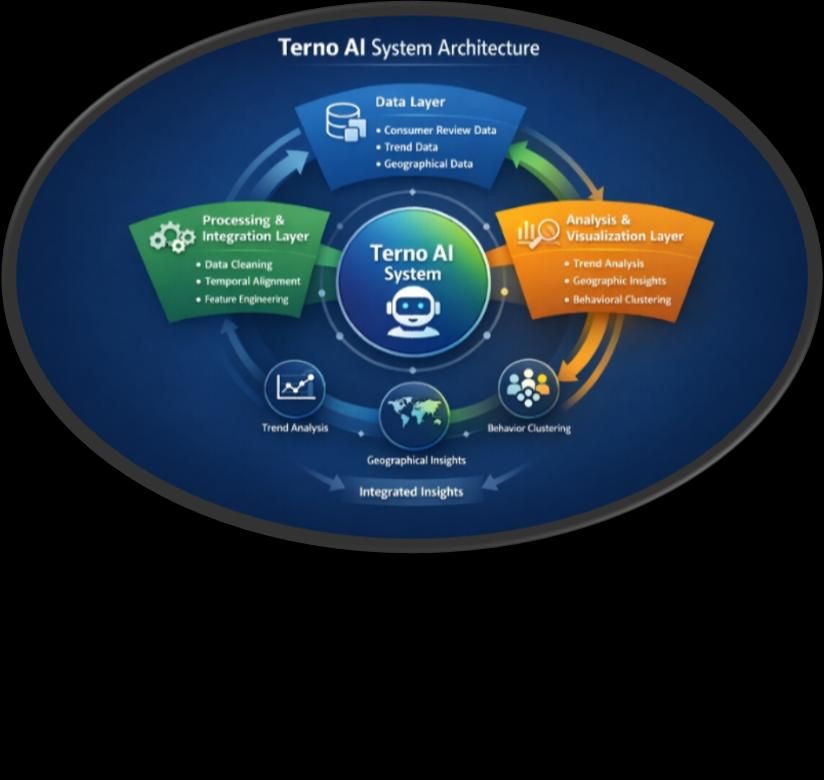
The proposed solution follows a structured data-driven architecture that integrates multiple data sources and analytical components to evaluate the relationship between global skincare trends and consumer behavior. The system is implemented using Terno AI, which enables seamless data processing and analysis through a prompt-driven workflow.
5.1 Overview of the Architecture
The system consists of three main layers:
- Data Layer
- Processing and Integration Layer
- Analysis and Visualization Layer
These layers work together to transform raw data into actionable insights.
5.2 Data Layer
The data layer includes three primary sources:
Consumer Behavior Data
- Amazon cosmetics dataset (~1.3 million records)
- Features: ProductId, ProductType, Rating, Timestamp
Trend Data (Time-Based)
- Global interest in: Aesthetic skincare (injectables), Organic skincare
Geographical Data (Country-Level)
- Country-wise distribution of organic vs aesthetic preferences
These datasets provide complementary perspectives on consumer behavior and market trends.
5.3 Processing and Integration Layer
In this layer, data from multiple sources is cleaned, transformed, and integrated.
Key operations include:
Data Cleaning: removal of inconsistencies (e.g., percentage symbols, formatting issues); conversion of trend values into numerical format
Temporal Alignment: mapping trend data to corresponding years in the review dataset; ensuring consistency between behavioral and trend data
Feature Engineering: creation of derived variables such as trend gap (aesthetic − organic) and aggregated product-level ratings
Data Aggregation: transformation from row-level data to product-level summaries, enabling meaningful behavioral analysis and clustering
This layer ensures that all datasets are aligned and ready for analysis.
5.4 Analysis and Visualization Layer
This layer performs the core analytical tasks of the system:
1. Trend Analysis
Time-series evaluation of aesthetic and organic trends
Identification of growth patterns and variability
2. Geographical Analysis
Country-level comparison of preferences
Identification of aesthetic-leaning countries, organic-dominant countries, and balanced markets
Visualization using diverging bar charts and scatter plots
3. Behavioral Analysis
Evaluation of product-level ratings
Correlation analysis between trends and user ratings
4. Machine Learning Module
Application of K-means clustering for segmentation
Grouping products based on rating and trend exposure
Identification of distinct behavioral segments
5.5 Data Flow
The system follows a sequential data flow:
- Raw datasets are ingested into the system
- Data is cleaned and standardized
- Trend data is aligned with behavioral data
- Features are engineered and aggregated
- Analytical models and visualizations are applied
- Insights are generated and interpreted
This pipeline ensures a smooth transition from raw data to structured insights.
5.6 Role of Terno AI
The entire architecture is implemented within Terno AI, which provides:
Prompt-driven data exploration
Automated data transformations
Integrated visualization capabilities
Support for large-scale datasets
This significantly reduces the complexity of traditional data analysis workflows and enables rapid iteration across multiple analytical steps.
6. Implementation Details
This section describes the practical implementation of the proposed framework, including dataset preparation, integration, analytical steps, and machine learning techniques used to evaluate the relationship between global skincare trends and consumer behavior.
6.1 Datasets Used
The implementation utilizes three primary datasets collected from publicly available sources, providing complementary perspectives on consumer behavior, temporal trends, and geographical variation.
Amazon Cosmetics Review Dataset: This dataset was obtained from the Kaggle repository [5] and contains over 1.3 million product reviews. It includes key attributes such as product identifiers (ProductId), product categories (ProductType), user ratings (Rating), and timestamps (Timestamp). This dataset serves as the primary source for analyzing consumer behavior and product-level satisfaction.
Global Trend Dataset (Time-Based): Trend data was collected from Google Trends, capturing worldwide search interest over time for aesthetic skincare (e.g., injectable procedures) and organic skincare. The dataset provides a normalized index of search popularity, which was used to analyze temporal changes in global skincare trends.
Geographical Dataset (Country-Level Preferences): Country-level preference data was derived from Google Trends, representing the relative distribution across different countries for organic skincare and aesthetic skincare. The data is expressed as percentage values, enabling comparative analysis of regional preferences and identification of dominant skincare trends at the country level.
6.2 Data Preprocessing
Data preprocessing was performed to ensure consistency and usability across all datasets.
Amazon Dataset Processing
Conversion of timestamp values into year format using datetime functions
Adjustment of year values to align with the analysis period (2020–2024)
Removal of invalid or missing entries
Trend Dataset Processing
Selection of relevant columns (date, aesthetic, organic)
Conversion of percentage values into numerical format
Transformation of date values into yearly aggregates
Geographical Dataset Processing
Removal of percentage symbols (%)
Conversion to numerical values
Standardization of column names (organic, aesthetic)
6.3 Data Integration
To enable unified analysis, the trend dataset was aggregated at the yearly level and merged with the Amazon dataset based on the year attribute.
Year-wise averages of aesthetic and organic trends were computed
These values were mapped to corresponding product-level records
Records with missing trend values were removed
This integration allowed each product rating to be analyzed within the context of prevailing global trends.
6.4 Feature Engineering
Additional features were created to enhance analytical capability:
Trend Gap (aesthetic − organic): Represents the difference between aesthetic and organic trend values
Aggregated Product-Level Ratings: Product-level averages were computed to reduce noise from individual user ratings
These features enabled more meaningful analysis of relationships between trends and consumer behavior.
6.5 Analytical Workflow
The implementation followed a structured analytical workflow:
1. Trend Analysis
Time-series evaluation of aesthetic and organic trends
Identification of growth patterns and variability over time
2. Geographical Analysis
Country-level comparison of organic and aesthetic preferences
Calculation of trend gap to measure dominance
Identification of organic-dominant countries, aesthetic-leaning countries, and balanced markets
3. Behavioral Analysis
Evaluation of product-level ratings
Analysis of rating distribution across time and trend conditions
Correlation analysis between ratings and trend variables
6.6 Machine Learning Implementation
Regression Analysis
An initial regression approach was applied to predict product ratings using year, aesthetic trend (botox), and organic trend (skincare). However, the model demonstrated extremely low predictive performance, indicating that these features do not sufficiently explain variation in user ratings.
Clustering-Based Segmentation
To address this limitation, an unsupervised machine learning approach was adopted. K-means clustering was applied to product-level data using average rating and trend gap as features. This approach enabled the identification of distinct behavioral segments without relying on predictive relationships.
7. Results and Analysis
This section presents the findings of the proposed framework, combining time-based trend analysis, geographical analysis, and machine learning-based segmentation to evaluate the relationship between global skincare trends and consumer behavior.
7.1 Temporal Trend Analysis
The analysis of global trend data reveals distinct patterns in the evolution of skincare preferences over time.
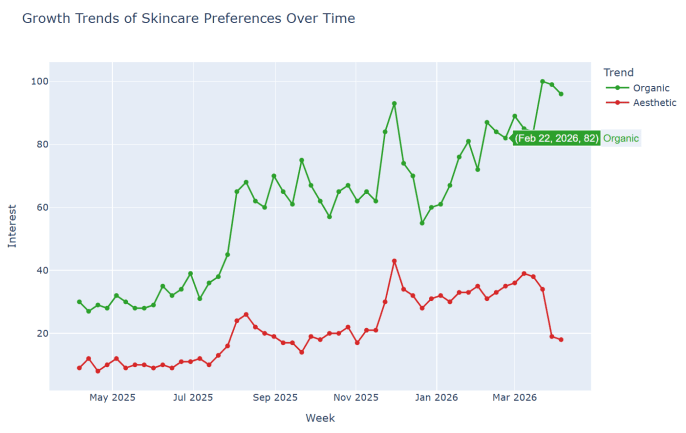
The results indicate that aesthetic skincare interest exhibits a consistent upward trend over the analysis period, reflecting increasing global attention toward injectable and advanced cosmetic procedures. In contrast, organic skincare maintains relatively stable behavior, with minor fluctuations across years.
| Year | Aesthetic (Botox) | Organic (Skincare) |
|---|---|---|
| 2020 | 51.92 | 56.50 |
| 2021 | 63.00 | 52.58 |
| 2022 | 66.17 | 49.58 |
| 2023 | 68.75 | 52.58 |
| 2024 | 73.83 | 51.08 |
Table 1: Yearly Average Trend Values
This divergence suggests that while modern aesthetic treatments are gaining popularity, traditional skincare practices continue to remain relevant in consumer routines.
7.2 Geographical Distribution of Preferences
To understand regional variation, country-level analysis was conducted using organic and aesthetic preference data.
| Country | Organic (%) | Aesthetic (%) | Gap |
|---|---|---|---|
| Belgium | 99 | 1 | -98 |
| Indonesia | 27 | 73 | +46 |
Table 2: Outlier Countries Based on Preference Gap
Belgium represents an extreme organic-dominant case, while Indonesia is the only strong aesthetic-dominant outlier. These results highlight significant heterogeneity in global skincare preferences.
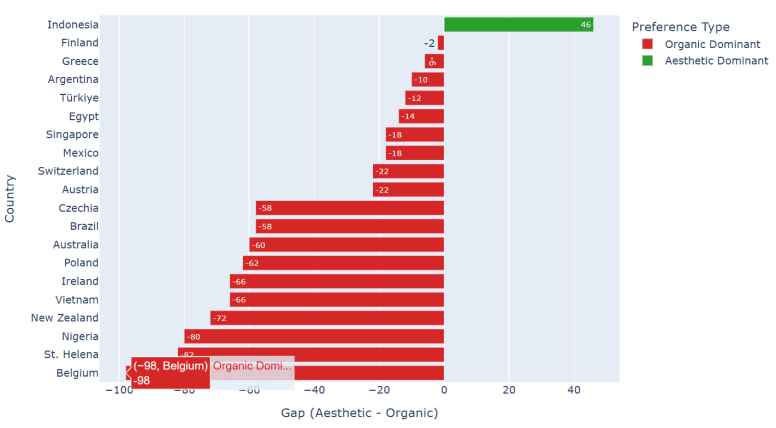
The diverging visualization illustrates the dominance of organic skincare across most countries, as evidenced by predominantly negative gap values (organic > aesthetic). Only a limited number of countries show notable inclination toward aesthetic preferences.
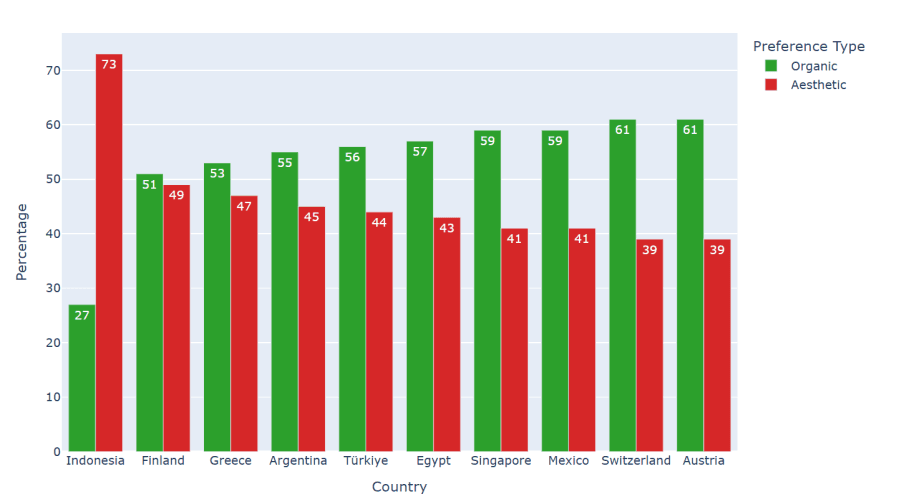
The comparison highlights that most top aesthetic-focused countries still exhibit higher organic skincare preference than aesthetic interest. Indonesia stands out as the only country with a strong aesthetic dominance, while other countries such as Finland and Greece remain relatively balanced. This indicates that even in markets with higher aesthetic interest, organic skincare continues to play a significant role.
7.3 Country-Level Distribution Analysis
A scatter-based representation was used to analyze the distribution of countries across preference dimensions.
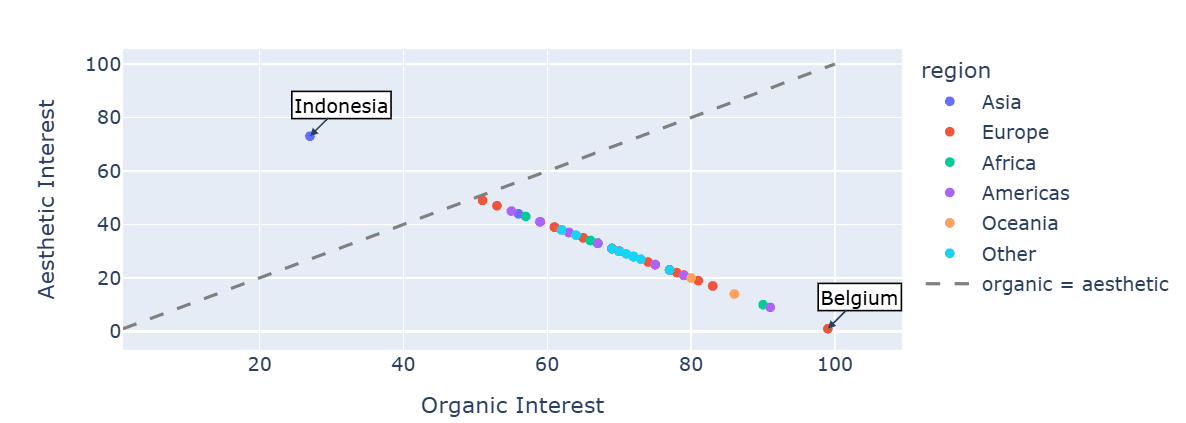
The scatter plot provides a comprehensive view of global distribution:
The majority of countries lie below the diagonal line (organic = aesthetic), indicating stronger organic preference
Only a small number of countries appear above the diagonal, confirming limited aesthetic dominance
Regions such as Oceania (e.g., Australia, New Zealand) show strong organic clustering
Asia exhibits higher variability, including the only aesthetic-dominant case (Indonesia)
This visualization confirms that global trends do not translate uniformly across regions and that consumer preferences are highly context dependent.
7.4 Machine Learning-Based Segmentation
Initial correlation and regression analysis indicated no significant relationship between global trends and user ratings; therefore, clustering was applied to explore hidden behavioral patterns. Given the weak predictive relationship, an unsupervised learning approach was applied to uncover hidden patterns.
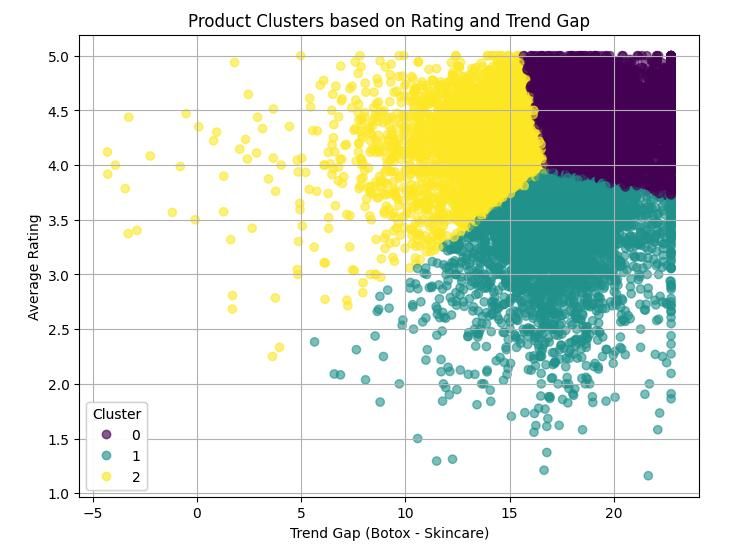
K-means clustering was performed on product-level data using average rating and trend gap (aesthetic − organic).
| Cluster | Avg Rating | Avg Trend Gap | Count |
|---|---|---|---|
| 0 | 4.40 | 18.43 | 12,850 |
| 1 | 3.42 | 17.37 | 4,883 |
| 2 | 4.23 | 14.33 | 6,105 |
Table 3: Cluster Summary
Cluster Interpretation
Cluster 0 (High Satisfaction Group): Products with high ratings and strong exposure to global trends
Cluster 1 (Low Satisfaction Group): Products with significantly lower ratings despite similar trend conditions
Cluster 2 (Moderate Group): Products with relatively stable ratings and lower trend influence
Key Insight from Clustering
The clustering results reveal that products exposed to similar global trend conditions can exhibit significantly different rating behaviors. This confirms the presence of latent behavioral segments, indicating that consumer satisfaction is influenced by factors beyond global trends.
7.5 Summary of Findings
The combined analysis leads to several key observations:
Aesthetic skincare trends are increasing globally over time, indicating a growing interest in advanced cosmetic procedures.
Organic skincare remains dominant across most countries, suggesting continued reliance on traditional skincare practices.
Significant geographical variation exists in consumer preferences, highlighting the influence of regional and cultural factors.
Distinct behavioral segments emerge under similar trend conditions, indicating that consumer responses are not uniform.
These findings demonstrate the complexity of consumer behavior in the skincare domain and emphasize that global trends do not directly translate into consistent behavioral outcomes, reinforcing the need for integrated and multi-level analytical approaches.
8. Conclusion
This study proposed a data-driven framework to analyze the relationship between global skincare trends and consumer behavior by integrating large-scale review data, trend data, and geographical insights. The analysis demonstrated that while interest in aesthetic skincare is increasing globally, organic skincare continues to dominate across most regions, indicating coexistence rather than substitution.
The results further showed that global trends do not directly influence consumer satisfaction, as reflected by the lack of strong correlation between trend variables and product ratings. However, clustering analysis revealed the presence of distinct behavioral segments, indicating that similar trend conditions can lead to different consumer responses. This highlights the importance of considering underlying behavioral patterns rather than relying solely on trend indicators.
From a methodological perspective, the study demonstrates the effectiveness of combining trend analysis, geographical analysis, and unsupervised machine learning to capture multi-level insights. The use of Terno AI enabled efficient data exploration and integration, supporting a structured and scalable analytical workflow.
9. Future Work
Future research can extend this framework in several directions:
Incorporating additional features such as product price, brand, and user demographics to improve behavioral modeling
Applying advanced machine learning techniques, including deep learning and recommendation systems
Expanding geographical analysis using more granular regional or city-level data
Extending the analysis to other domains such as healthcare, fashion, or consumer electronics
Investigating causal relationships between trends and purchasing behavior using longitudinal data
References
- G. P. Zhang, "Neural networks for classification: A survey," IEEE Transactions on Systems, Man, and Cybernetics, vol. 30, no. 4, pp. 451–462, 2000.
- B. Jun, "A study on the use of Google Trends for forecasting," Technological Forecasting and Social Change, vol. 109, pp. 1–9, 2016.
- L. Schiffman and J. Wisenblit, Consumer Behavior, 12th ed. Pearson, 2019.
- Jain, "Data clustering: 50 years beyond K-means," Pattern Recognition Letters, vol. 31, no. 8, pp. 651–666, 2010.
- Kaggle, "Amazon Beauty Product Review Dataset," Available: https://www.kaggle.com/
- Google Trends, "Google Trends: Explore search interest over time," Available: https://trends.google.com/
- Institute for Social and Policy Research (ISAP), "Global Skincare Preference Dataset," Available: [Dataset Source]
- Terno AI (Chat # 1): https://cosmetic.app.terno.ai/chat/5e7ae01d-be6c-4816-bb0b-d2237c1bf9d0
- Terno AI (Chat # 2): https://cosmetic.app.terno.ai/chat/a782c455-7cb6-4046-b50e-83174c2e0460
See the complete analysis and conversation history on Terno AI:
Chat #1: https://cosmetic.app.terno.ai/chat/5e7ae01d-be6c-4816-bb0b-d2237c1bf9d0
Chat #2: https://cosmetic.app.terno.ai/chat/a782c455-7cb6-4046-b50e-83174c2e0460
Read the full whitepaper

18 August 2026
The Honest Number Was 83%: Leakage, Abstention, and a Complaint Router You Can Actually Deploy
The same complaint-routing model scores 96.3% or 83.2% depending on which three columns you leave in the training data. The high number is the intake form being read back to you. This is what the leakage audit found before a single model was trained, why 83.2% is the honest figure, and how the same model — given permission to say "I don't know" — becomes deployable at 90.7% accuracy on 79.5% of traffic.

29 July 2026
EdgeGuard: AI-Driven Predictive Maintenance for Power Transformers
Power transformers are among the most critical assets in electrical distribution infrastructure. Their unexpected failure can result in power outages, safety hazards, equipment damage, expensive repairs, and long service interruptions. Traditional transformer maintenance practices often rely on periodic manual inspection, offline testing, or run-to-failure maintenance. These methods are expensive, slow, labor-intensive, and unable to detect rapidly developing faults in real time. EdgeGuard is an AI-driven, edge-computing predictive maintenance system designed to continuously monitor transformer health and forecast failures before catastrophic damage occurs. The system acts as a retrofittable “Digital Doctor” for distribution transformers by combining low-cost industrial sensors, an ESP32 microcontroller, local intelligence, machine learning-based risk prediction, autonomous relay control, and a real-time web dashboard. The proposed system monitors six major transformer health indicators: temperature, humidity, vibration, oil level, current, and voltage. These signals are normalized and processed through a Multi-Layer Perceptron neural network to classify transformer condition and estimate failure risk. If the predicted risk crosses a critical threshold of 80%, EdgeGuard automatically triggers a relay through GPIO 26 to isolate the transformer from the electrical network. The system also supports secure remote control, dashboard monitoring, API-key-based hardware authentication, JWT-based user access, WebSocket live updates, and automatic live-hardware detection. With an estimated deployment cost of approximately ₹3,850, EdgeGuard offers a low-cost alternative to conventional transformer monitoring systems. Its cloud-independent operation and edge-based decision-making make it especially useful for rural and semi-urban distribution grids where connectivity and maintenance resources are limited.

28 July 2026
ANALYZING TOXIC USER BEHAVIOR AND RISK PATTERNS IN ONLINE GAMING PLATFORMS
This study shows that behavioral data alone can't reliably predict gaming toxicity — but a risk-based model combining behavioral and engineered features does a much better job of flagging the small segment of high-risk users driving disproportionate harm.